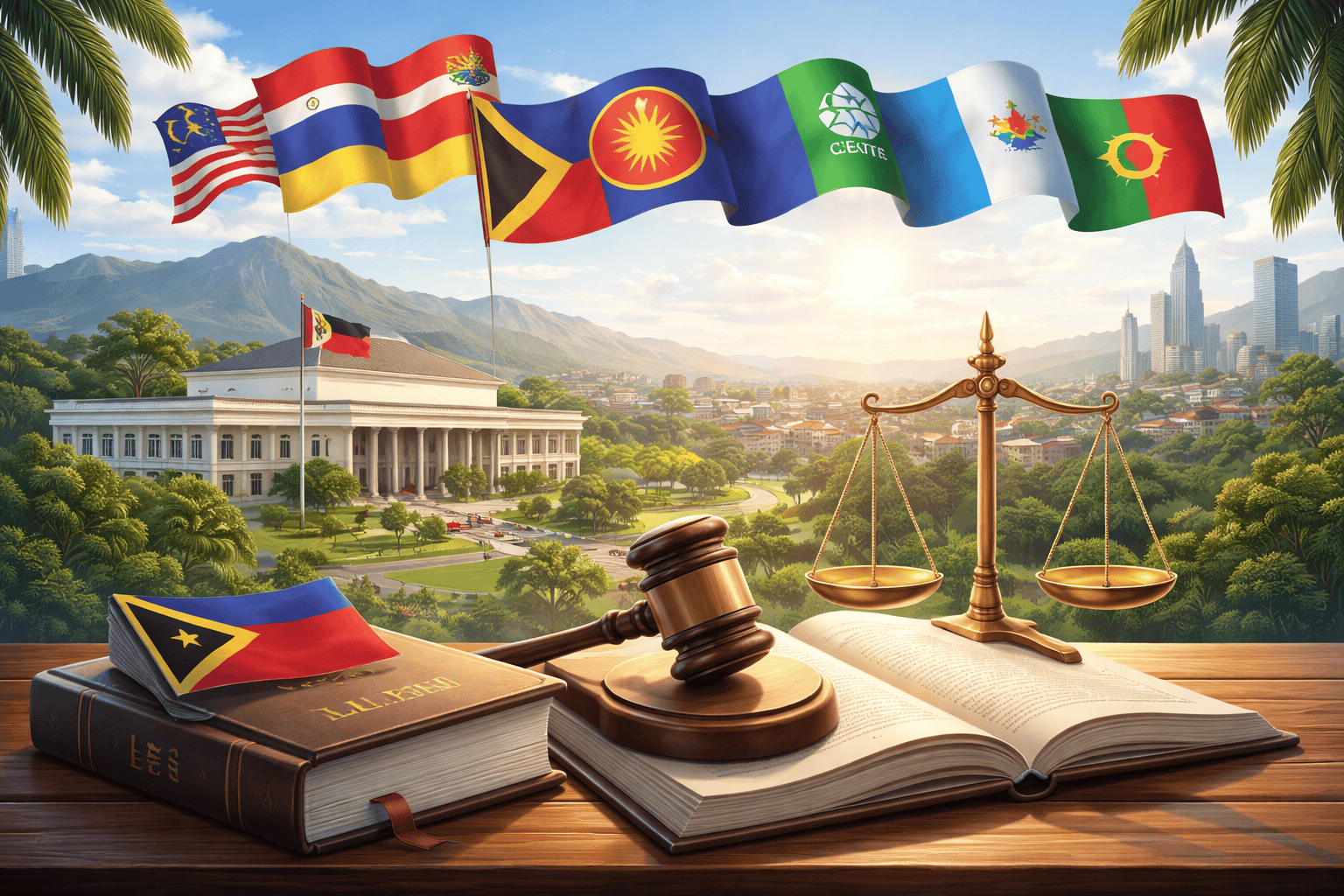
Universal and National Legal Principles:
Published on January 10, 2026
Law is a fundamental pillar of social order, designed to regulate behavior, protect rights, and promote justice. While many legal principles are considered universal, the way laws are implemented, interpreted, and enforced remains primarily national. This distinction is especially relevant for Timor-Leste as it deepens its integration into regional and international communities such as ASEAN and the CPLP.
At the universal level, legal systems across the world share core principles. These include respect for human dignity, equality before the law, legal certainty, due process, proportionality of sanctions, and accountability of public authorities. Such principles are reflected in international conventions and treaties that Timor-Leste has ratified since restoring its independence. They form a common ethical and legal foundation that facilitates cooperation between states.
However, universal principles do not mean uniform laws. Each country translates these values into its own legal framework, shaped by history, constitutional arrangements, legal tradition, culture, and social priorities. In the case of Timor-Leste, the legal system reflects a unique combination of civil law influences, constitutional norms, and post-independence nation-building priorities. Portuguese remains a legal language, while national legislation continues to evolve to respond to economic development, public health, food safety, labor relations, and administrative governance.
Timor-Leste’s integration into ASEAN brings increased interaction with countries that often operate under different legal traditions, regulatory approaches, and business environments. Similarly, engagement within the CPLP connects Timor-Leste with Portuguese-speaking countries across several continents, each with distinct legal systems despite a shared linguistic and historical heritage. These connections create opportunities—but also legal complexity.
What is lawful or customary in one ASEAN or CPLP member state may not be lawful in another. Regulations on investment, professional practice, employment, land use, food and drug control, data protection, or commercial contracts can differ significantly. For individuals, companies, NGOs, or professionals operating across borders, assumptions based on foreign legal experience can lead to serious legal risks.
This is why consultation with national or local legal experts in Timor-Leste is essential before engaging in any activity with legal implications. Local lawyers and legal advisors understand not only the written law but also administrative practices, enforcement realities, and institutional procedures. Their guidance helps ensure compliance, prevent disputes, and protect both legal rights and reputations.
In conclusion, while universal legal principles provide a shared foundation, law is ultimately applied within national boundaries. As Timor-Leste strengthens its role within ASEAN and the CPLP, respect for national legal frameworks—supported by informed local consultation—remains a cornerstone of responsible engagement and sustainable development.